

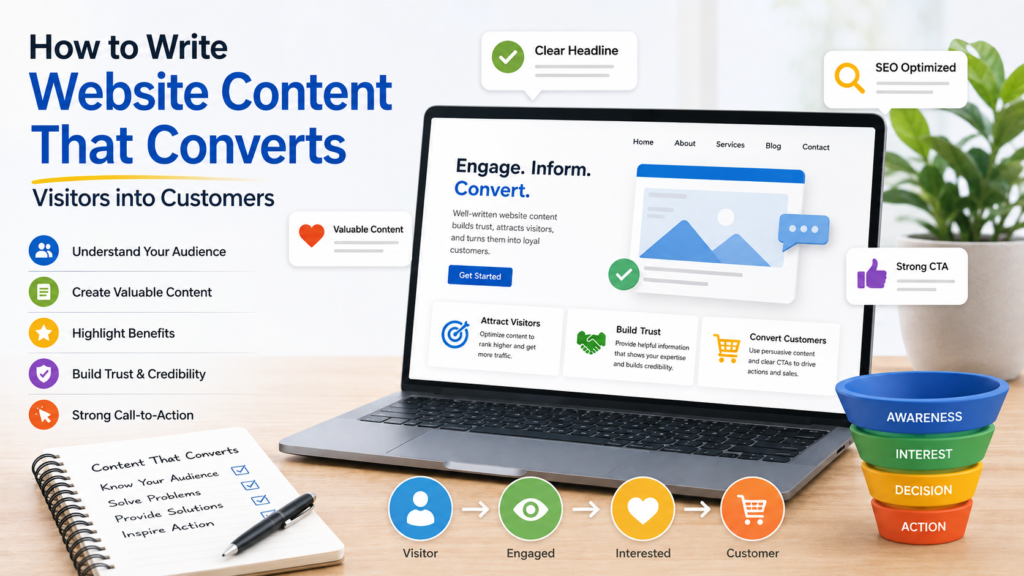
Creating a beautiful website is only half the battle. The real challenge begins when visitors land on your pages and decide whether to stay or leave. Many businesses invest thousands of dollars in professional web design but fail to convert visitors into customers because their website content doesn’t communicate value, build trust, or encourage action.
Website content is much more than words on a page. It acts as your digital salesperson, representing your business 24/7. Every headline, paragraph, and call-to-action should guide visitors toward making a decision. Whether your goal is to generate leads, sell products, or increase inquiries, high-quality website content plays a critical role in achieving those objectives.
Search engines like Google also reward websites that provide helpful, informative, and user-focused content. This means well-written website copy not only improves conversions but also strengthens your SEO performance, helping more potential customers discover your business online.
In this guide, you’ll learn proven strategies for writing website content that attracts visitors, keeps them engaged, builds trust, and ultimately converts them into loyal customers.
Why Website Content Matters More Than Ever
Modern consumers are smarter than ever before. Before making a purchase, they research businesses, compare services, read reviews, and evaluate websites carefully.
If your website content is confusing, generic, or overly promotional, visitors will leave within seconds.
Great website content accomplishes several important goals simultaneously. It explains your services clearly, demonstrates your expertise, addresses customer concerns, answers important questions, and motivates readers to take the next step.
Effective content also improves important SEO metrics like average session duration, page engagement, and organic rankings. Search engines prioritize websites that satisfy user intent by providing valuable and relevant information.
Businesses that consistently publish useful website content often experience higher organic traffic, increased customer trust, better search visibility, and stronger conversion rates.
Understand Your Audience Before Writing
One of the biggest mistakes businesses make is writing about themselves instead of their customers.
Visitors don’t care how long you’ve been in business unless you explain how your experience benefits them.
Instead, focus on understanding your audience’s problems, goals, and motivations.
Ask yourself:
- What challenges are they facing?
- What questions are they searching on Google?
- What solutions are they hoping to find?
- What concerns might stop them from making a purchase?
For example, if someone searches for website content writing services, they aren’t looking for a history lesson about your company. They want to know whether you can create content that improves rankings, attracts visitors, and generates sales.
Customer-focused content always performs better because it directly addresses the reader’s needs.
Start with a Powerful Headline
Your headline is the first thing visitors notice.
A weak headline can cause users to leave immediately, while a compelling headline encourages them to continue reading.
An effective headline should communicate a clear benefit rather than simply describing the topic.
Instead of writing:
Website Content Writing
Write something like:
Website Content That Attracts More Visitors and Converts Them into Paying Customers
The second version immediately explains what readers will gain.
Strong headlines often include benefits, numbers, emotional triggers, or solutions to common problems.
Focus on Benefits Instead of Features
Many businesses spend too much time talking about features.
Customers care more about benefits.
For example:
Feature:
“We provide SEO content writing.”
Benefit:
“We create SEO-optimized website content that helps your business rank higher on Google, attract qualified visitors, and increase sales.”
Notice the difference.
Benefits explain how your services improve the customer’s life or business.
Whenever possible, connect every feature with a real-world outcome.
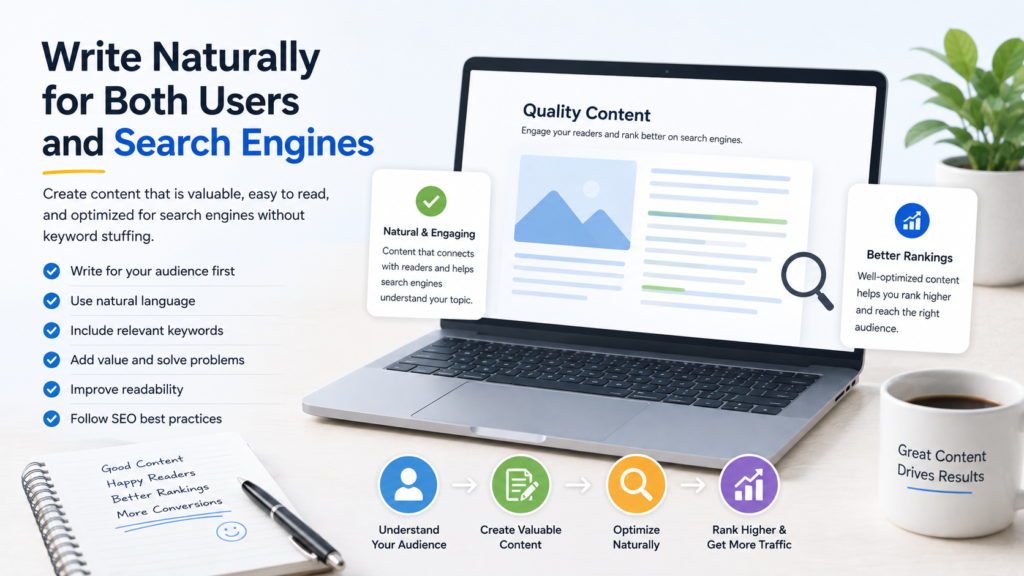
Write Naturally for Both Users and Search Engines
Years ago, stuffing keywords throughout a page could improve rankings.
Today, Google’s algorithms prioritize helpful, natural, and informative content.
Instead of forcing the keyword website content writing into every paragraph, write naturally while using related terms such as:
- SEO website content
- Website copywriting
- Content strategy
- Conversion copywriting
- Website optimization
- SEO copywriting
- Customer-focused content
- Landing page copy
- Content marketing
Using related keywords helps search engines better understand your topic while keeping your content enjoyable for readers.
Build Trust with Valuable Information
Trust is one of the biggest factors affecting conversions.
Visitors are unlikely to contact or purchase from businesses they don’t trust.
Your content should demonstrate expertise by providing practical advice instead of making exaggerated marketing claims.
Include helpful explanations, examples, statistics, real experiences, or step-by-step guidance whenever possible.
For instance, rather than saying:
“We’re the best content writing agency.”
Explain why:
“Our writers research your industry, analyze competitors, identify customer search intent, and create SEO-friendly content designed to improve visibility and conversions.”
Specific information feels more credible than vague claims.
Keep Your Content Easy to Read
Most people don’t read every word on a webpage.
Instead, they scan.
That’s why readability is extremely important.
Use short paragraphs, clear headings, simple language, and logical formatting to help readers quickly find the information they’re looking for.
Avoid technical jargon unless your audience specifically expects it.
Even when discussing SEO or digital marketing, explain concepts in simple terms.
Clear writing creates a better user experience and encourages visitors to stay longer on your website.
Answer Questions Before Customers Ask
High-converting content anticipates customer concerns.
Think about the questions potential clients frequently ask before contacting your business.
Examples include:
- How long will the project take?
- What does your service include?
- How much does it cost?
- Why should I choose your company?
- What results can I expect?
Answering these questions within your content removes uncertainty and increases confidence.
This approach also improves your chances of appearing in Google’s featured snippets and AI-generated search results.
Create Clear and Persuasive Calls-to-Action
Even excellent content can fail if it doesn’t tell visitors what to do next.
Every important page should include a clear call-to-action (CTA).
Instead of using vague phrases like:
“Learn More”
Use action-oriented CTAs such as:
- Request Your Free Quote
- Book a Free Consultation
- Get Started Today
- Contact Our Team
- Schedule a Discovery Call
Effective CTAs create urgency while making the next step obvious.
Don’t overwhelm users with too many choices. Guide them toward one primary action on each page.
Write Service Pages That Solve Problems
Many businesses make the mistake of using their service pages as digital brochures. They simply list what they offer without explaining why it matters. A high-converting service page focuses on the customer’s challenges first and then presents your service as the solution.
For example, instead of saying, “We provide web development services,” explain how your service helps businesses generate leads, improve user experience, increase conversions, or strengthen their online presence. Customers are more interested in the outcomes than the technical process.
Every service page should answer four important questions:
- What problem does this service solve?
- Why should someone choose your business?
- What benefits will they receive?
- What should they do next?
When your content follows this structure, visitors can quickly understand the value of your service and feel more confident taking action.
Use Storytelling to Build Emotional Connections
Facts and features are important, but stories make your content memorable. People naturally connect with real situations, challenges, and success stories.
Instead of saying your company delivers excellent results, describe a realistic scenario. For example, imagine a small business owner whose website receives hundreds of visitors each month but generates very few inquiries. After improving the website content by focusing on customer pain points, adding persuasive calls-to-action, and optimizing for search intent, the business starts receiving more qualified leads and higher conversion rates.
Stories help visitors picture themselves achieving similar results.This emotional connection builds trust and makes your message more persuasive without sounding overly promotional.
Optimize Every Page for Search Intent
Ranking on Google is no longer just about inserting keywords into paragraphs. Search engines now prioritize content that fully satisfies the reason behind a user’s search.
Before writing any page, ask yourself what the visitor wants to achieve. Someone searching for “how to write website content” wants educational guidance, while someone searching for “website content writing services” is likely looking for a professional agency.
Your content should match that intent by providing the right information in the right format. Educational articles should teach, service pages should persuade, and product pages should help visitors make buying decisions.
Meeting search intent increases user satisfaction, improves engagement, and boosts your chances of ranking higher in search results.
Improve Readability with Simple Language
Many businesses assume that complex language sounds more professional. In reality, simple writing is far more effective.
Use short sentences, familiar words, and a conversational tone. Break long sections into smaller paragraphs and organize your ideas with descriptive headings.
Readers should never struggle to understand your message. If your content is easy to read, visitors are more likely to stay on your website, explore additional pages, and complete your desired action.
Good readability also improves accessibility, making your content useful for a wider audience.
Add Social Proof to Increase Trust
People trust other customers more than marketing messages. Including social proof throughout your website helps reduce hesitation and strengthens credibility.
You can add client testimonials, case studies, success stories, industry certifications, awards, or positive statistics. If available, include measurable results such as increased traffic, improved rankings, or higher conversion rates.
For example:
“Our SEO content strategy helped a local business increase its organic traffic by 120% within six months while generating significantly more qualified leads.”
Specific examples are much more convincing than general claims because they provide evidence of your expertise.
Create Strong Calls-to-Action Throughout the Page
Many websites include only one call-to-action at the bottom of the page. However, visitors may decide to contact you long before reaching the end.
Place relevant calls-to-action naturally throughout your content. After explaining a benefit or solving a common problem, invite readers to take the next step.
Examples include:
- Request Your Free Quote
- Schedule a Free Consultation
- Talk to Our Experts
- Start Your Project Today
- Contact Our Team
Your CTA should clearly explain what happens next and make the process feel simple and risk-free.
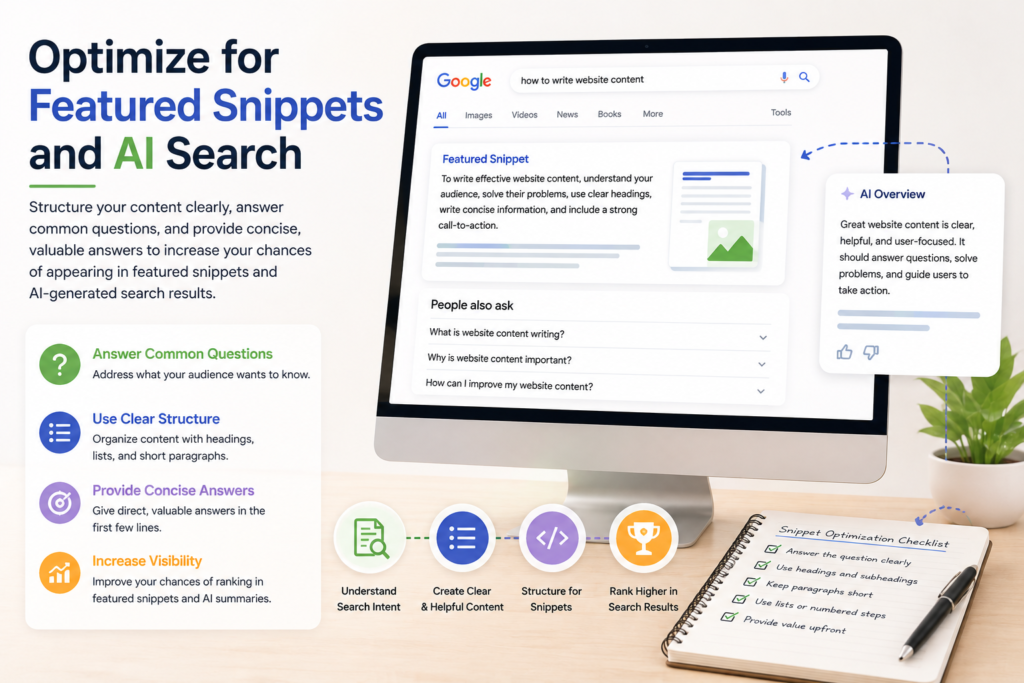
Optimize for Featured Snippets and AI Search
Modern search results increasingly display direct answers, AI-generated summaries, and featured snippets. To improve your chances of appearing in these results, structure your content clearly.
Answer common questions using concise paragraphs, organize information with descriptive headings, and include numbered steps where appropriate. Define important concepts before expanding on them, and keep your explanations focused on solving the user’s problem.
This structured approach helps both search engines and readers understand your content more effectively.
Common Website Content Mistakes to Avoid
Even well-designed websites can lose potential customers because of avoidable content mistakes.
One of the biggest problems is writing about the business instead of the customer. Visitors want to know how you can help them, not simply read your company history.
Another common mistake is using vague or generic language. Claims such as “best quality” or “excellent service” provide little value unless they are supported by examples or proof.
Keyword stuffing is another issue. Repeating the same keyword excessively makes content difficult to read and may negatively affect SEO. Instead, use natural language and related terms throughout the page.
Finally, many websites fail because they have weak or missing calls-to-action. Every page should guide visitors toward one clear next step.
Website Content Checklist
Before publishing any page, review it using this checklist:
- Does the headline clearly explain the benefit?
- Does the introduction capture attention?
- Is the content focused on customer needs?
- Are SEO keywords used naturally?
- Is the content easy to read?
- Does every section provide value?
- Are trust signals included?
- Is there at least one strong call-to-action?
- Are grammar and spelling error-free?
- Does the page fully answer the user’s search intent?
Completing this checklist helps ensure your content is optimized for both search engines and real visitors.
Conclusion
Writing website content that converts visitors into customers requires more than attractive wording. It demands a clear understanding of your audience, a focus on solving real problems, and a strategy that balances SEO with user experience. Every headline, paragraph, and call-to-action should guide readers toward making a confident decision.
By creating content that is informative, trustworthy, and easy to understand, you can improve search visibility, build stronger relationships with potential customers, and increase conversions. Whether you’re writing a homepage, service page, or blog post, always prioritize value over promotion. When your content genuinely helps people, search engines and users are far more likely to reward your efforts.