

In today’s fast-paced digital marketplace, a website serves as the primary digital storefront for any local business. When potential clients search for local service providers—whether it is home repairs, professional consulting, or commercial services—they expect instant loading times, flawless mobile usability, and direct answers to their queries.
Industry benchmarks show that if a mobile site takes longer than 3 seconds to load, over 53% of mobile visitors abandon the page entirely.
Site speed is no longer just a technical metric; it is a critical driver of user conversion and organic search visibility. Search engines like Google explicitly prioritize fast, secure, and user-friendly websites in search results.
In this comprehensive guide and detailed case study breakdown, we reveal the exact technical roadmap and execution strategy used to transform a lagging local business website into a high-ranking, fast-loading lead generator.
The Challenge: High Bounce Rates and Stagnant Search Traffic
Our client, an established local service provider, came to us with a familiar set of challenges. Despite having a strong physical reputation, high-quality offerings, and positive client reviews, their online channel was underperforming.
They were spending resources on marketing, yet organic traffic remained minimal, and online inquiries had plateaued.
When our engineering team conducted a full technical, performance, and SEO audit, we identified three main root causes holding the website back:
1. Critical Core Web Vitals Failure
The site was running on a bloated infrastructure with unoptimized assets, non-minified scripts, and heavy third-party plugins.
- Mobile PageSpeed Score: 38 / 100
- Largest Contentful Paint (LCP): 4.8 seconds (Google’s recommended threshold is under 2.5 seconds).
- Cumulative Layout Shift (CLS): High layout instability during page load, causing accidental misclicks for mobile users.
2. Technical SEO Neglect
Although the website had basic pages for its services, search engines struggled to understand the site’s contextual and geographic relevance:
- Absence of structured schema markup to communicate business entity details to search crawlers.
- Incorrect heading structure (multiple H1 tags, missing secondary H2/H3 subheadings).
- Duplicate meta titles and missing description tags across key landing pages.
3. Suboptimal User Experience & Conversion Traps
Because the site took nearly five seconds to render main visual content, bounce rates spiked on mobile devices. Key call-to-action buttons were below the fold, and contact forms loaded slowly, driving potential leads straight to local competitors.
The Strategic Plan: Engineering for Speed and Local Search Dominance
To deliver sustainable results without sacrificing site functionality, we implemented a structured 4-pillar roadmap focusing on Core Web Vitals optimization, technical SEO architecture, local schema implementation, and conversion rate optimization.
| Pillar | Category | Key Focus Areas |
| 1 | Core Web Vitals | • WebP Image Prep • Script Deferral • Server-Side Caching |
| 2 | Technical SEO | • Clean Architecture • Heading Hierarchy • Canonical Tags |
| 3 | Local Schema | • LocalBusiness Data • Service Area Context • FAQ Structuring |
| 4 | Conversion Rate Optimization | • Above-the-Fold CTAs • Fast Lead Forms |
Step 1: Core Web Vitals & Speed Optimization Overhaul
Page speed directly influences how search engines evaluate your site quality. Our main goal was to achieve green PageSpeed scores across both mobile and desktop while maintaining a clean user experience.
Media & Image Optimization
Images represent a large percentage of overall page weight. We executed the following asset optimizations:
- Conversion to WebP: Converted legacy JPEGs and PNGs into lightweight, next-generation WebP media files, reducing image payloads by an average of 65%.
- Responsive Image Scaling: Implemented proper image dimension attributes so browsers do not need to recalculate layout geometry during page rendering.
- Lazy Loading Implementation: Deferred loading images below the fold until the user scrolls down, reducing initial HTTP request size.
Code Minification & Script Management
JavaScript and CSS files can easily block page rendering if not managed properly:
- Minification & Combination: Stripped out whitespace, comments, and unused code blocks across all stylesheet and script assets.
- Non-Critical JS Deferral: Applied defer and async flags to secondary scripts (like tracking pixels and non-essential tools) so the browser could prioritize visual content rendering first.
- Elimination of Render-Blocking Resources: Restructured critical inline CSS so the main above-the-fold content renders instantly.
Server-Side Caching & Database Cleaning
To reduce Server Response Time (TTFB – Time to First Byte):
- Configured aggressive page caching and browser caching rules to serve pre-rendered HTML to returning users.
- Cleared database bloat, old post revisions, and transient data to optimize backend query speeds.
Step 2: On-Page & Technical SEO Architecture Fixes
Fixing page speed gets users to stay; fixing technical SEO ensures search engine crawlers index and rank your pages accurately.
Streamlining URL & Heading Structures
We reorganized the entire site content architecture to build context:
- Logical H1-H6 Hierarchy: Ensured each page maintained a single H1 heading describing the primary topic, followed by contextual H2 and H3 subheadings.
- Targeting High-Intent Local Keywords: Integrated descriptive long-tail terms naturally into titles, headings, and body text without keyword stuffing.
- Meta Optimization: Drafted unique meta titles and descriptive meta descriptions for every service landing page.
Strategic Contextual Internal Linking
Internal links distribute page equity and help crawlers navigate your platform efficiently:
- Created contextual anchor links inside blog posts connecting directly to core service landing pages.
- Added clear footer and header navigation links ensuring all primary pages remain reachable within 2-3 clicks from the homepage.
Step 3: Implementing Local Schema & Structured Data
Structured data provides search engines with standardized clues about a page and its content. For a local business, schema markup is essential for rich snippet generation and map-pack visibility.
We injected JSON-LD schema markup across key site sections:
- LocalBusiness Schema: Detailed exact entity information including legal business name, address, phone number (NAP), operating hours, geo-coordinates, and accepted payment types.
- Service Schema: Clearly defined specific services offered, target service areas, and pricing ranges.
- FAQ Page Schema: Structured frequently asked questions on service pages to capture rich result real estate in search engine results pages (SERPs).
Step 4: Conversion Rate Optimization (CRO)
Bringing organic traffic to a website is only half the battle. Once visitors arrive, the site must guide them seamlessly toward becoming a qualified lead.
Fast, Mobile-Friendly Forms: Streamlined lead generation forms down to essential fields only, reducing submission friction on mobile devices.
Above-the-Fold Value Proposition: Added clear, concise headline messaging at the very top of the homepage so users immediately understand the service offered.
Prominent Call-to-Action (CTA) Placements: Positioned direct contact buttons (“Get a Free Quote”, “Book a Consultation”) in the main header and at strategic intervals throughout page content.
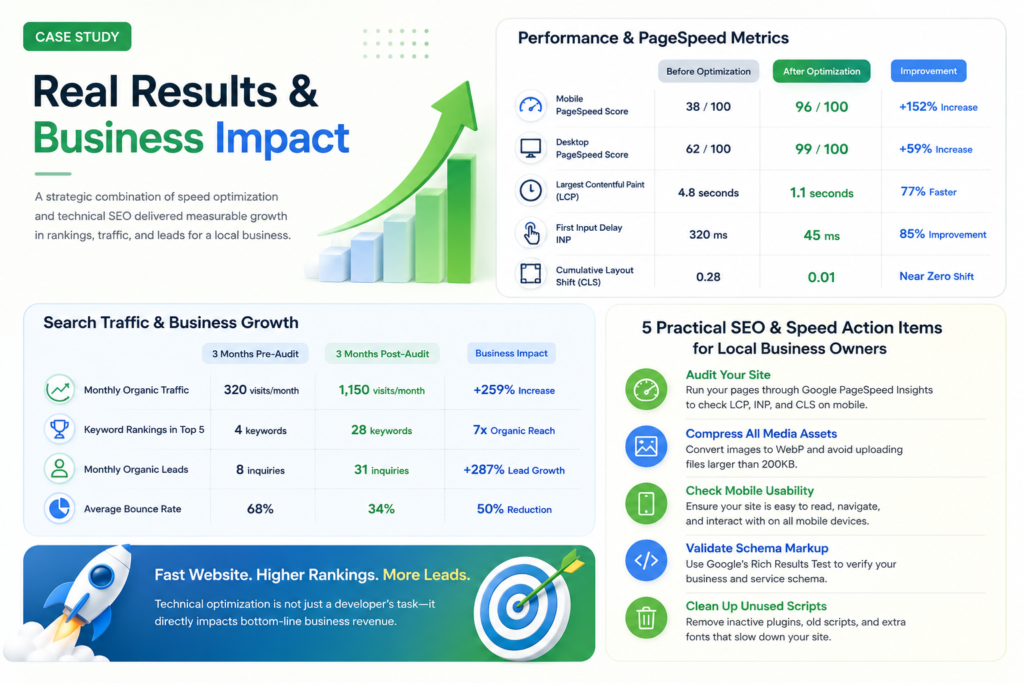
Case Study: Real Results & Business Impact
The results of this dual performance and technical SEO strategy exceeded initial benchmarks across speed, organic visibility, and lead generation.
Performance & PageSpeed Metrics
| Metric | Before Optimization | After Optimization | Improvement |
| Mobile PageSpeed Score | 38 / 100 | 96 / 100 | +152% Increase |
| Desktop PageSpeed Score | 62 / 100 | 99 / 100 | +59% Increase |
| Largest Contentful Paint (LCP) | 4.8 seconds | 1.1 seconds | 77% Faster |
| First Input Delay / INP | 320 ms | 45 ms | 85% Improvement |
| Cumulative Layout Shift (CLS) | 0.28 | 0.01 | Near Zero Shift |
Search Traffic & Business Growth
| Growth Metric | 3 Months Pre-Audit | 3 Months Post-Audit | Business Impact |
| Monthly Organic Traffic | 320 visits/month | 1,150 visits/month | +259% Increase |
| Keyword Rankings in Top 5 | 4 keywords | 28 keywords | 7x Organic Reach |
| Monthly Organic Leads | 8 inquiries | 31 inquiries | +287% Lead Growth |
| Average Bounce Rate | 68% | 34% | 50% Reduction |
Key Takeaway: Technical optimization is not just a developer’s task—it directly impacts bottom-line business revenue. By reducing load time to under 1.5 seconds and clarifying search context through technical SEO, organic lead volume nearly quadrupled.
5 Practical SEO & Speed Action Items for Local Business Owners
If you want to evaluate your own website’s current health, here are five immediate steps you can take today:
- Audit Your Site via Google PageSpeed Insights: Run your primary landing pages through the official testing tool to see your LCP, INP, and CLS benchmarks on mobile.
- Compress All Media Assets: Ensure no raw JPEG or PNG files over 200KB are uploaded directly to your site. Convert them to WebP formats where possible.
- Check Mobile Usability: Open your site on a mobile device and verify that call buttons, forms, and navigation menus are easy to tap and read.
- Validate Schema Markup: Use Google’s Rich Results Test tool to ensure your business entity, address, and service data are correctly structured.
- Clean Up Unused Scripts: Remove inactive plugins, obsolete tracking scripts, or excessive font libraries that slow down server response times.
Scale Your Business with a Fast, Optimized Web Presence
A slow website silently drains revenue, pushes potential clients to competitors, and suppresses organic search rankings. Investing in clean technical architecture, optimized page delivery, and structured local SEO creates a scalable foundation for business growth.
At remotehive.agency, we specialize in custom web development, core speed engineering, and high-impact B2B SEO strategies designed to deliver measurable client results.