

AI vs Automation: Key Differences Explained
In today’s fast-moving tech world, two terms get confused more than almost any other — AI vs automation. Many people assume they mean the same thing, but the reality is that these two technologies work in fundamentally different ways. In this blog, we’ll break down the difference between AI and automation, walk through real-life examples, and help you decide which one is the right fit for your business.
What Is Automation?
Automation refers to a system that follows a fixed, pre-defined set of rules. It completes repetitive tasks without human intervention, but there’s no “thinking” involved — it simply executes instructions exactly as programmed.
Robotic process automation (RPA) is the best-known example of this category. RPA software handles tasks like data entry, invoice processing, and other repetitive digital work. Robotic process automation automation systems help large companies save both time and operational costs.
Given this growth, robotic process automation jobs are in high demand right now, as more companies look to automate their back-office operations.
What Is Artificial Intelligence?
On the other hand, Artificial Intelligence (AI) is an advanced technology that learns from data, identifies patterns, and makes decisions — much like a human would. If you’re wondering what is the best artificial intelligence system for your needs, the honest answer is: it depends on the use case. Different AI tools excel at business analytics, while others are built specifically for customer service.
AI includes machine learning, natural language processing, and deep learning. Unlike automation, AI doesn’t just follow instructions — it can make decisions in new, unforeseen scenarios based on what it has learned.
Automated Intelligence vs Artificial Intelligence
It’s also worth understanding automated intelligence vs artificial intelligence as a concept. Automated intelligence usually refers to rule-based systems that appear somewhat “smart” but aren’t fully autonomous. Artificial intelligence, however, genuinely learns and improves over time through exposure to data.
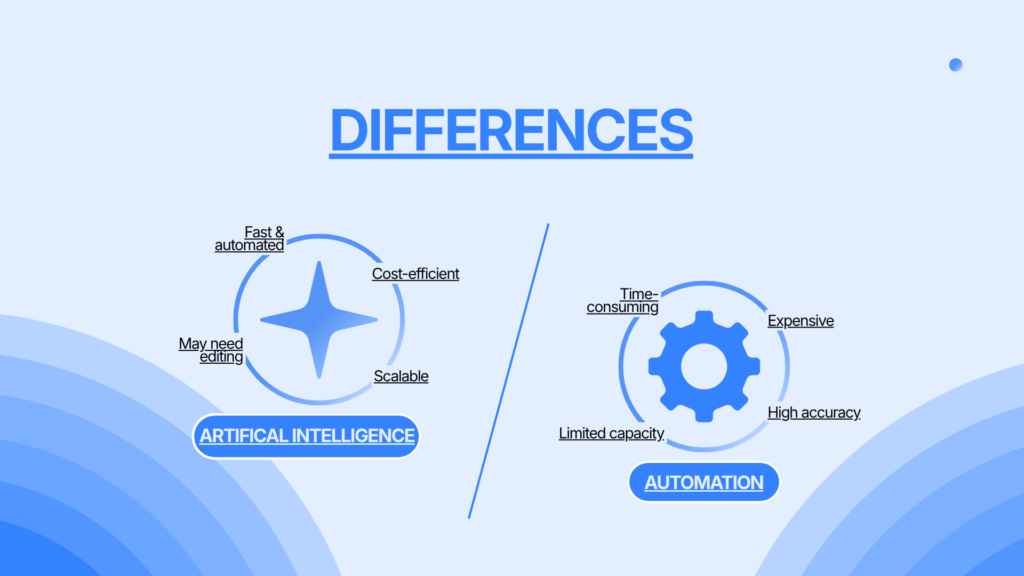
AI vs Automation: Core Differences
| Feature | Automation | Artificial Intelligence |
| Working Style | Follows fixed rules | Learns from data |
| Decision Making | None | Makes its own decisions |
| Flexibility | Low | High |
| Examples | RPA, scheduled tasks | Chatbots, recommendation engines |
The same logic applies to automation vs machine learning — machine learning is actually a subset of AI that learns from data patterns, while automation simply follows a static set of pre-programmed rules.
AI Vs Automation Examples
Whether we realize it or not, we interact with both technologies every single day:
- Automation example: An auto-reply email system that sends the same response to every incoming message.
- AI example: Netflix’s recommendation engine, which analyzes your watch history to suggest new content.
- AI vs automation examples combined: A smart chatbot that understands context and generates new responses is AI. But if that same chatbot only replies based on fixed keyword matches, that’s automation.
Smart Home Automation Setup Guide
If you’re looking to turn your home into a smart home, here’s a basic smart home automation setup guide:
- Choose a smart hub (Google Home, Alexa, or SmartThings)
- Install smart lights and plugs
- Connect security cameras to your app
- Automate your thermostat to save energy
- Integrate a voice assistant for hands-free control
This setup is pure automation — until it incorporates AI-based learning (like adjusting temperature based on your habits over time), at which point it becomes a true “AI-powered smart home.”
Artificial Intelligence and Automation: How They Work Together
Many people assume artificial intelligence and automation are competitors, but in reality, they complement each other perfectly. Modern businesses rely on intelligent automation, where AI’s learning capabilities are combined with automation’s speed and consistency.
This combination allows companies to run far more efficient operations — automation handles the repetitive workload, while AI takes care of the complex decision-making.
AI in Business: Real World Applications
The use of AI in business is growing rapidly across every industry. Some of the most common applications include:
- Customer support chatbots
- Sales forecasting
- Fraud detection systems
- Personalized marketing campaigns
- HR recruitment screening
Many companies now hire an artificial intelligence automation agency to help streamline their business processes efficiently while integrating AI-driven insights.
Automation Tooling Systems and ATS
Automation tooling systems play a critical role in business operations, helping companies streamline their workflows. Similarly, ATS automation tooling (Applicant Tracking Systems) speeds up recruitment by automatically scanning resumes and filtering the best candidates.
Robotic automation tools such as UiPath, Automation Anywhere, and Blue Prism help companies automate manual, repetitive tasks at scale.
AI Application and Automated Testing
The scope of AI application is incredibly broad — from healthcare to finance, AI is being adopted everywhere. One particularly important area is software development, where automated testing AI tools help detect bugs and speed up the testing process. These tools are smarter than traditional automated testing because they can generate new test cases on their own.
AI Technology Podcasts 2026
If you want to stay up to date on everything happening in AI and automation, following AI technology podcasts 2026 is a great way to do it. These podcasts cover the latest trends, tools, and case studies, keeping you current with what’s happening across the industry.
How to Automate Business Processes
If you’re looking to bring automation into your company, follow these steps:
- Identify tasks that are repetitive and rule-based
- Choose the right automation tool for your needs
- Test it on a small scale first
- Train your employees on the new system
- Gradually add AI-based features to make the system smarter
This is how you can effectively automate business processes and boost overall efficiency.
AI Vs Automation: Which One Is Better?
The answer really depends on your specific needs:
- If you have repetitive, rule-based tasks → Automation is the better choice
- If you need complex decision-making and learning capability → AI is the stronger option
- Most companies today use a combination of both for maximum efficiency
Conclusion
AI vs automation are two distinct technologies, but each plays an important role in modern business. Automation gives you speed and consistency, while AI gives you intelligence and adaptability. The smartest approach is to find the right combination of both based on your business needs — and that’s exactly what intelligent automation is all about.
If you want to future-proof your business, now is the time to start understanding and implementing AI in business and automation tooling systems.